
Last Updated:
How to 3D Print Without Supports
3D printing is a great tool for making quick prototypes or custom parts. In many cases, Fused Deposition Modeling (FDM) printing requires supports. This is because melted plastic cannot always hold itself up while printing. These extra support structures take more material, time, and cleanup. Below are a few ways to reduce or avoid using supports and save both time and money.
Minimize Overhangs
When possible, try to reduce overhangs. An overhang happens when printed material sticks out from the main body of a part without anything underneath it for support.
A common rule is to avoid overhangs greater than 45 degrees. Anything steeper than that can sag, droop, or fail during printing. Ideally, the angle from the edge of the overhang back to the main body should stay at or below 45 degrees.
Another way to reduce overhang issues is to change the print orientation. For example, flipping a part upside down can move risky overhangs to a safer position.
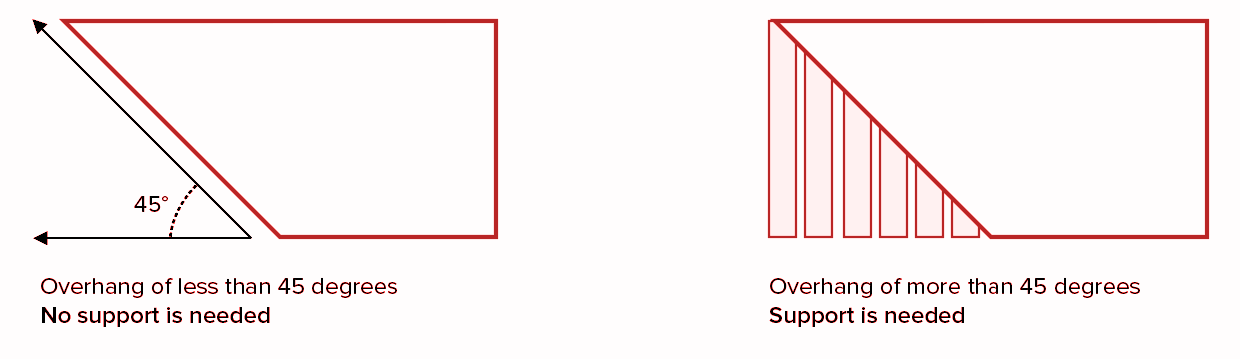
Image Sourced from Mohit via GrabCAD
Self-Supporting Geometry
Designing parts that support themselves is one of the best ways to avoid supports, but it can take some practice. Certain shapes naturally print better than others.
For example, bridges can often be redesigned as arches, which print more reliably without sagging. Adjusting the orientation of a part can also allow gravity and layer stacking to work in your favor. Small design changes like these can make a big difference in print quality.
Process Choice
Choosing the right printing process can completely eliminate the need for supports. Processes like Multi Jet Fusion (MJF) and Selective Laser Sintering (SLS) use powdered material. During printing, the surrounding powder holds the part in place and acts as natural support.
Because of this, no added supports are needed in the file. This reduces material use and cuts down on post-processing time since there is no support removal required. These processes may involve outsourcing and shipping, which can add cost, but they often allow for larger, stronger, and more complex parts.
As 3D printing continues to grow, new tips and best practices are being discovered all the time. Learning and experimenting with different methods can help you save time and money while improving your prints. Explore more resources to find ideas, tips, and guides to improve your results.