
Last Updated:
Sports equipment has always evolved alongside technology, but 3D printing is pushing that evolution into new territory. What used to take weeks of tooling and mold-making can now be prototyped, tested, and refined in days. At JawsTec, we’re watching this shift closely, and here’s a look at where 3D printing in sports is headed.
Airless Balls Are Already Here
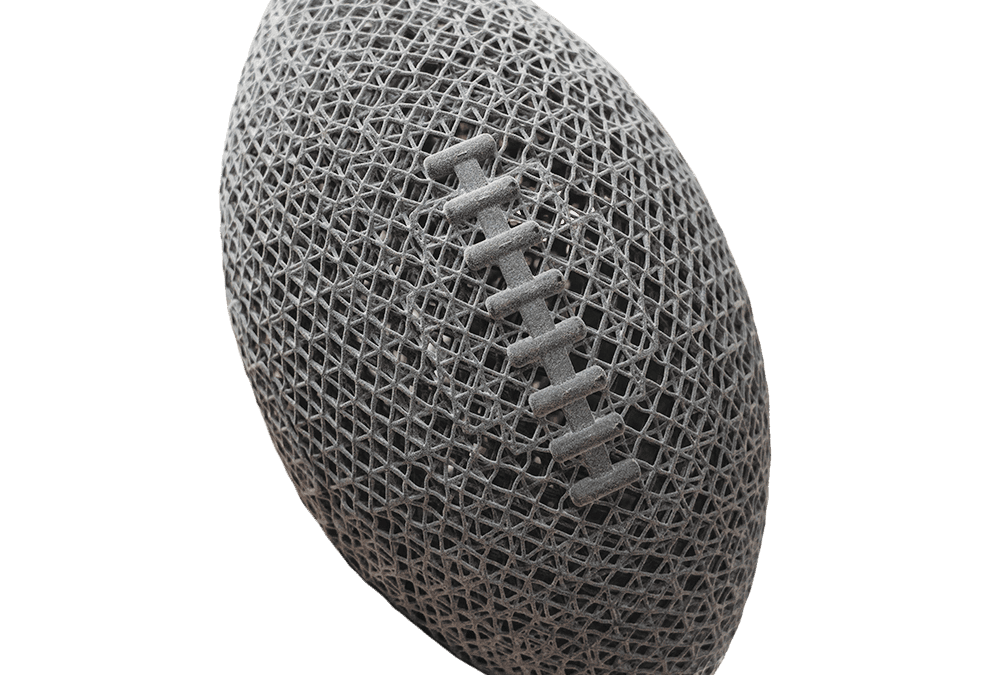
One of the most surprising developments is the 3D printed airless ball. Footballs and basketballs built with lattice structures instead of an inflated bladder are no longer a concept — they’ve already been made. These balls hold their shape through engineered internal geometry rather than air pressure, which means no more flat balls, no more re-inflating before a game, and consistent performance no matter the conditions. It’s a small example of how additive manufacturing can rethink a product that hasn’t changed much in over a century.
Rackets, Helmets, and Custom Gear
Beyond balls, 3D printing is making its way into the equipment athletes use every day. Tennis and pickleball rackets can be printed with tuned flex and weight distribution, letting players get a feel that’s dialed in specifically for their swing. Helmets are another area seeing major gains, with printed lattice structures offering impact protection that can be customized to the shape of an individual athlete’s head.
Protective Gear Built for the Individual
Protective equipment is a natural fit for 3D printing because fit and impact absorption matter so much. We’re seeing printed:
- Helmets
- Knee pads
- Shoulder pads
- Shin guards
Instead of one-size-fits-most padding, printed protective gear can be shaped around an athlete’s actual body and tuned for the specific impacts their sport produces.
Faster Prototypes, Faster Products
Maybe the biggest shift isn’t a single product at all — it’s speed. 3D printing lets equipment makers move from an idea to a testable prototype almost overnight. Instead of waiting on traditional manufacturing timelines, designers can iterate quickly, test with real athletes, and refine before committing to full production. That speed also opens the door to smaller custom runs, which used to be too expensive to justify.
Recovery and Orthotics
The same technology helping athletes perform is also helping them heal. 3D printed orthotic devices and recovery equipment can be custom-fit to an athlete’s exact anatomy, supporting a faster and more comfortable recovery process than off-the-shelf alternatives.
The Manufacturing Process Behind It
Most of this equipment is being produced using TPU (thermoplastic polyurethane) on powder bed processes like MJF (Multi Jet Fusion) and SLS (Selective Laser Sintering). TPU’s flexibility and durability make it well suited for sports applications, from cushioning to impact absorption, while powder bed printing allows for complex, lightweight lattice structures that would be difficult or impossible to produce with traditional manufacturing.
What This Means Going Forward
3D printing in sports is moving from novelty to necessity. As materials and printing processes continue to improve, expect to see more custom-fit equipment, faster product development cycles, and gear that’s designed around the individual athlete rather than the average one. It’s an exciting space, and we’re just getting started.
Interested in how 3D printing could apply to your product or industry? Reach out to JawsTec to learn more.