
Can 3D Printing Compete at Million-Unit Scale?
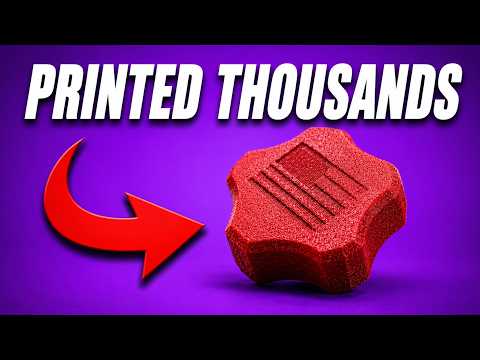
Design for additive manufacturing transforms how products reach mass production. A recent case study from 3D print farm operator Slant 3D proves this point dramatically. They redesigned a simple BBQ scrubber knob to compete with injection molding at scale.
The project targeted millions of units. This isn’t prototype territory. It’s full production competition with traditional manufacturing.
Why Original Designs Fail at Scale
The original knob design worked fine for injection molding. It featured thick walls and solid geometry. For 3D printing, these choices create problems.
Thick sections require more material. More material means longer print times. Longer prints increase costs exponentially at scale.
- Original design: Heavy, solid construction
- Print time: Too long for competitive pricing
- Material usage: Excessive for the function
- Cost result: Unable to compete with molding
Design for Additive Manufacturing Principles
The redesign followed proven DFM principles. Engineers hollowed the part while maintaining strength. They optimized wall thickness for the printing process.
These changes weren’t compromises. The redesigned knob performs identically. Users can’t tell the difference during normal operation.
Key Design Changes
Wall thickness dropped to the minimum functional requirement. Internal geometry shifted to support the printing process naturally. The team eliminated features that added time without adding value.
- Reduced wall thickness saves material
- Optimized geometry cuts print time
- Maintained full mechanical function
- Simplified post-processing requirements
Cost Reduction Results
The redesigned knob achieved competitive pricing with injection molding. This matters for procurement teams evaluating manufacturing options. Understanding when 3D printing beats injection molding requires examining total production costs.
3D printing eliminates tooling costs entirely. No molds mean faster time to market. Design changes happen without expensive retooling.
When to Choose Additive Manufacturing
This case study reveals important decision criteria. 3D printing competes best when designs optimize for the process. Simply printing an injection-molded design rarely works economically.
Engineers must design specifically for additive processes. Print orientation affects part strength and surface quality. These factors influence final product performance.
Practical Takeaways for Your Team
Procurement teams should request DFM reviews for new projects. Don’t assume existing designs transfer directly between processes. The manufacturing method should inform the design approach.
Engineers benefit from understanding process constraints early. Material costs and print times drive unit economics. Small design changes create massive cost differences at volume.
Getting Started with Production 3D Printing
JawsTec specializes in industrial additive manufacturing for production volumes. Our team reviews designs for manufacturability before quoting. This prevents costly surprises during production.
Consider Multi Jet Fusion or Selective Laser Sintering for production quantities. Both processes excel at functional parts in engineering-grade materials.
Next Steps for Your Project
Evaluate your current designs through an additive lens. Identify parts where tooling costs delay production. Calculate total cost including design iteration time.
Ready to explore production 3D printing? Request a quote from JawsTec to discuss your specific requirements. Our engineers help optimize designs for cost-effective mass production.
Sources
Source: We Made a Knob for SmarterEveryDay to Print Millions by Slant 3D (YouTube) — https://www.youtube.com/watch?v=F3ViXSLH_ZM
The Slant 3D BBQ-knob example is the right bar: DFM for millions is not print-the-CAD-as-is. Uniform walls, no mystery fillets, and geometry that orients cleanly on the bed beat pretty renders. If you are iterating a custom part before you lock production geometry, I have been using luphra.com — prompt or photo in, free STL download — then applying the same DFM checks (consistent walls, printable orientation, no zero-thickness edges) before quoting a farm. Treat the first printable STL as the design review, not the last mile.