
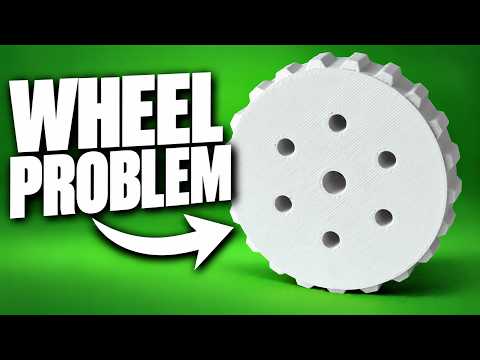
Why Standard Wheels Limit Robot Design
Robot engineers face a frustrating problem. They must design around whatever wheels exist in catalogs. This backwards approach limits innovation and performance.
Industrial 3D printing manufacturer Slant 3D recently highlighted this challenge. Their founder explained how catalog constraints forced design compromises during his robotics work. Custom 3D printed wheels offer a better path forward.
Instead of adapting robots to available components, engineers can now specify exact requirements. Diameter, width, tread pattern, and hub geometry become design choices—not limitations.
The Catalog Constraint Problem
Standard wheel catalogs offer limited options. You might find the right diameter but wrong width. Or the perfect tread but incompatible mounting holes.
This forces engineers into three bad choices:
- Redesign the robot around available wheels
- Accept performance compromises with imperfect wheels
- Pay for expensive custom tooling with long lead times
None of these options serve product development timelines well. Procurement teams know the pain of searching multiple suppliers for close-enough components.
How Design Constraints Cascade
Wheel selection affects the entire robot design. Ground clearance, turning radius, and load capacity all depend on wheel geometry. Motor selection follows from wheel diameter requirements.
When the ideal wheel doesn’t exist, compromises ripple through every subsystem. Engineers spend time solving problems that shouldn’t exist.
Custom 3D Printed Wheels Change the Equation
Additive manufacturing removes catalog constraints entirely. Engineers specify exactly what they need. The wheel gets produced to those specifications.
Modern industrial processes like Multi Jet Fusion produce wheels with excellent mechanical properties. Nylon-based materials handle real-world loads and environmental conditions.
Key advantages include:
- Exact diameter and width specifications
- Custom hub geometry for specific shafts and bearings
- Optimized tread patterns for your operating surface
- Integrated features like encoder rings or mounting points
- No minimum order quantities
Material Considerations for Functional Wheels
Material selection matters for wheeled applications. TPU (Thermoplastic Polyurethane) provides excellent grip and impact resistance. Nylon offers durability and dimensional stability.
Some applications benefit from multi-material approaches. A rigid nylon hub paired with a TPU tread combines the best properties of both materials.
From Prototype to Production
Custom wheels aren’t just for prototyping. Production runs benefit from the same design freedom. When your robot design is finalized, wheel production scales accordingly.
This eliminates the prototype-to-production gap. The exact wheels tested during development go into production units. No tooling changes or supplier transitions required.
Cost and Lead Time Benefits
Traditional custom wheels require mold tooling. Lead times stretch to weeks or months. Tooling costs must be amortized across large orders.
3D printed wheels ship in days. Design iterations happen quickly without tooling penalties. Small batches become economically viable.
For robotics applications, this speed matters. Product development cycles accelerate when components don’t create bottlenecks.
Design Guidelines for Printed Wheels
Successful wheel designs follow additive manufacturing principles. Build orientation affects strength in critical load paths.
Consider these factors when designing custom wheels:
- Wall thickness of 2-3mm minimum for structural integrity
- Draft angles on hub features for powder removal
- Spoke designs that transfer loads efficiently
- Integrated bearing seats with appropriate tolerances
Working with experienced manufacturing partners helps optimize designs. JawsTec engineers can review wheel designs for manufacturability before production begins.
Getting Started with Custom Wheels
Engineers ready to escape catalog constraints have options. Parametric design tools simplify custom wheel creation. Manufacturing partners handle production complexity.
The first step is defining your actual requirements. What diameter, width, and load capacity do you truly need? What mounting interface works best?
From there, request a quote from JawsTec to explore production options. Custom wheels can arrive in days, not months.
Stop designing robots around component catalogs. Start designing components around your robots.
Sources
Source: When I Built Robots, I Couldn’t Get Wheels by Slant 3D (YouTube) — https://www.youtube.com/watch?v=lzfQkK5Vg9g