
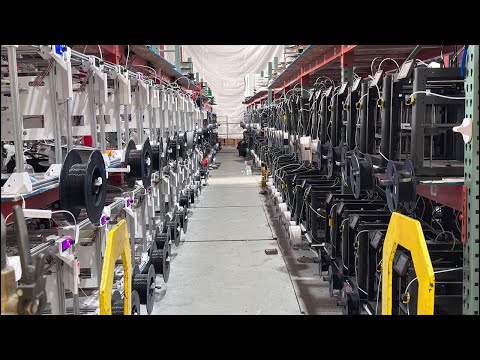
A print farm represents one of the most compelling approaches to scaling additive manufacturing. For engineers and procurement teams, understanding how these facilities operate unlocks new possibilities for production.
What Makes a Print Farm Different
Traditional manufacturing relies on expensive tooling and long setup times. A print farm flips this model by deploying hundreds or thousands of machines in parallel. Each unit produces parts simultaneously, creating massive throughput without molds or dies.
Companies like Slant 3D have pioneered this distributed manufacturing approach. Their mega print farm demonstrates how coordinated printer networks can achieve production volumes once reserved for injection molding.
Key Advantages for Production Teams
Print farms offer several benefits that matter to manufacturing professionals:
- Zero tooling costs eliminate upfront capital barriers
- Parallel production scales linearly with machine count
- Design changes happen instantly without retooling delays
- Mixed production runs multiple parts simultaneously
- Distributed capacity reduces single-point-of-failure risks
These advantages make print farms ideal for bridge production. Teams can validate products at scale before committing to traditional tooling investments.
When Print Farms Make Sense
Not every project fits the print farm model. Understanding the sweet spot helps procurement teams make informed decisions.
Ideal Applications
Print farms excel at medium-volume production runs. Think thousands to hundreds of thousands of units. They also handle complex geometries that would require expensive molds.
Products with frequent iterations benefit significantly. When designs change quarterly or monthly, eliminating tooling costs delivers major savings.
Volume Considerations
For very high volumes, injection molding may still offer lower per-part costs. The crossover point depends on part geometry, material requirements, and production timeline.
Engineers should evaluate total cost of ownership. Include tooling amortization, inventory carrying costs, and design flexibility value.
Technology Behind Print Farm Operations
Successful print farms require more than just machines. Automation and software coordination separate hobby setups from industrial operations.
- Automated part removal systems maintain continuous production
- Centralized monitoring tracks every machine in real-time
- Quality control systems catch defects before shipping
- Material handling automation ensures consistent feedstock
These systems enable 24/7 operation with minimal human intervention. Labor costs drop while throughput increases.
Material and Process Options
Print farms typically use FDM technology for its reliability and low material costs. However, industrial alternatives exist for demanding applications.
Multi Jet Fusion and Selective Laser Sintering offer superior mechanical properties. These powder-bed processes suit functional prototypes and end-use parts requiring better performance.
Choosing the Right Approach
Material requirements often dictate the best production method. Selecting the appropriate material requires understanding your part’s mechanical, thermal, and chemical demands.
JawsTec offers multiple industrial processes to match your specific requirements. Our engineering team can recommend the optimal approach for your production needs.
Getting Started with Production 3D Printing
Engineers exploring additive manufacturing for production should consider several factors. Start with a clear understanding of your volume requirements and quality standards.
Request samples from potential suppliers to validate part quality. Test functional properties under real-world conditions before committing to production volumes.
Ready to explore production additive manufacturing? Get a quote from JawsTec to see how industrial 3D printing fits your manufacturing strategy.
Sources
Source: Slant 3D MEGA Print Farm by Slant 3D (YouTube) — https://www.youtube.com/watch?v=tR2R9y89Riw