
Last Updated:
If you were to ask someone on the street, “How does 3D printing work?” most people could give you an answer that’s close to the truth. In most cases, a print head extrudes plastic to form a specific shape or design. Pretty simple.
For the most part, many 3D printing processes follow this same basic idea: material is pushed out of a nozzle to build a part layer by layer. However, 3D printing is a bit more complex than that explanation. The main 3D printers we use at JawsTec involve a few more steps than traditional printers.
Multi Jet Fusion: How It Works
First, what is MJF? MJF stands for Multi Jet Fusion. It describes the process HP printers use to create 3D printed parts.
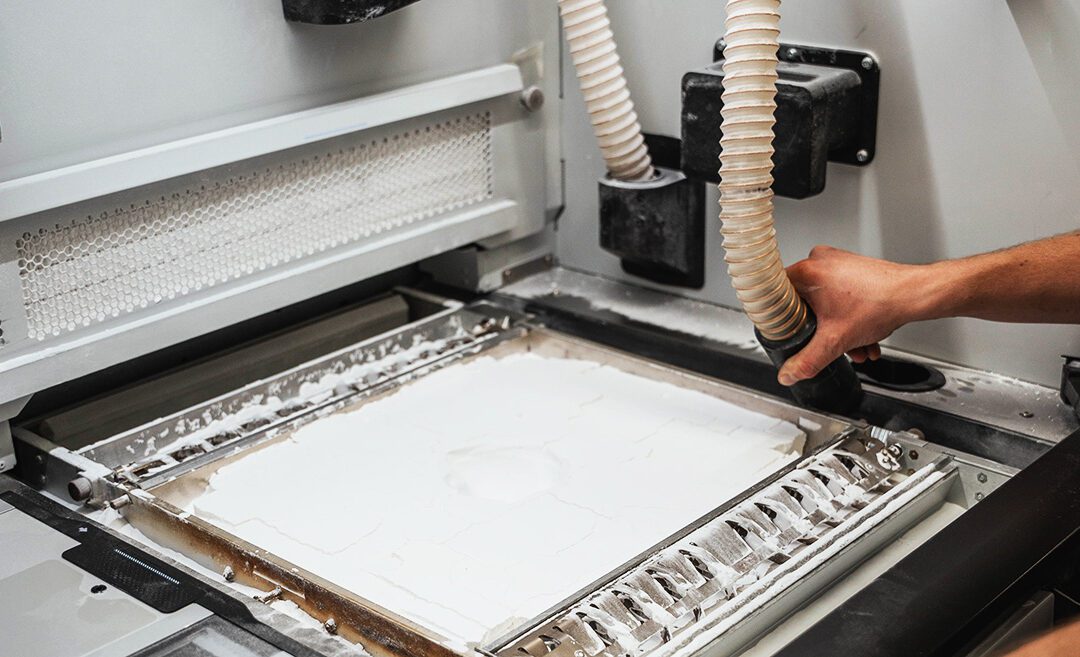
Multi Jet Fusion printers differ from traditional 3D printers in several keyways. The most obvious difference is that MJF printers do not use plastic filament. Instead, they use nylon powder. This powder is fine, typically white, and known for its strength and versatility.
The powder is loaded from a bin into a build unit. These build units are mobile, which makes unpacking and cleaning easier. Once the build unit is placed into the machine, the print begins. A thin layer of powder is spread across the build area. Next, a binding agent is applied to help define the part’s shape. Then, heat is used to fuse the material together. This process is repeated layer by layer until all parts are complete.
Once printing is finished, the build unit is removed and taken to an unpacking station. There, excess powder is removed and partially recycled. At this point, the part is complete and ready for use. Additional post-processing can still be done to achieve the desired look or finish.
A typical MJF print can take between 10 and 12 hours. While this may sound like a long time, the real advantage of MJF is its ability to produce parts in large quantities. A traditional 3D printer might produce 10 parts at the same time, while an MJF printer can produce many times that amount in a single build. Parts made with MJF are also stronger and more durable due to the printing process.
Another major difference between MJF and traditional printers is that no support structures are needed. The surrounding powder acts as natural support during printing. This reduces material waste and allows more parts to be printed at once, which helps lower overall costs.
In short, the main differences between traditional 3D printing and MJF come down to the materials used, the printing process, and production speed at scale. Traditional 3D printing is still a great option for simple parts. However, if you need industrial strength, advanced materials, and higher production volumes, MJF is an ideal choice. Each method has its own benefits and drawbacks, so choosing the right process depends on your specific project needs.
Multi Jet Fusion (MJF) vs Traditional 3D Printing (FDM)
| Feature | Multi Jet Fusion (MJF) | Traditional 3D Printing (FDM) |
| Printing Method | Powder-based process using binding agents and thermal fusion | Extrusion of melted plastic filament |
| Material Type | Nylon powder (PA materials) | Thermoplastic filament (PLA, ABS, PETG, etc.) |
| Part Strength | High strength and durability | Moderate strength, varies by material |
| Surface Finish | Smooth, uniform, and consistent | Visible layer lines |
| Support Structures | Not required (powder acts as support) | Required for overhangs and complex geometry |
| Production Volume | Ideal for batch and volume production | Best for low-volume or single parts |
| Print Time | Longer single print cycles (10–12 hours) | Shorter per-part print times |
| Design Freedom | Excellent—complex internal features possible | Limited by support requirements |
| Material Waste | Low (excess powder is partially recycled) | Higher due to supports and failed prints |
| Cost Efficiency | Cost-effective at medium to high volumes | Cost-effective for simple, low-volume parts |
| Typical Applications | End-use parts, housings, brackets, enclosures | Prototypes, fixtures, simple functional parts |
Want to know more about designing for MJF printing? Read our recommendation for designing for multi-jet fusion.