
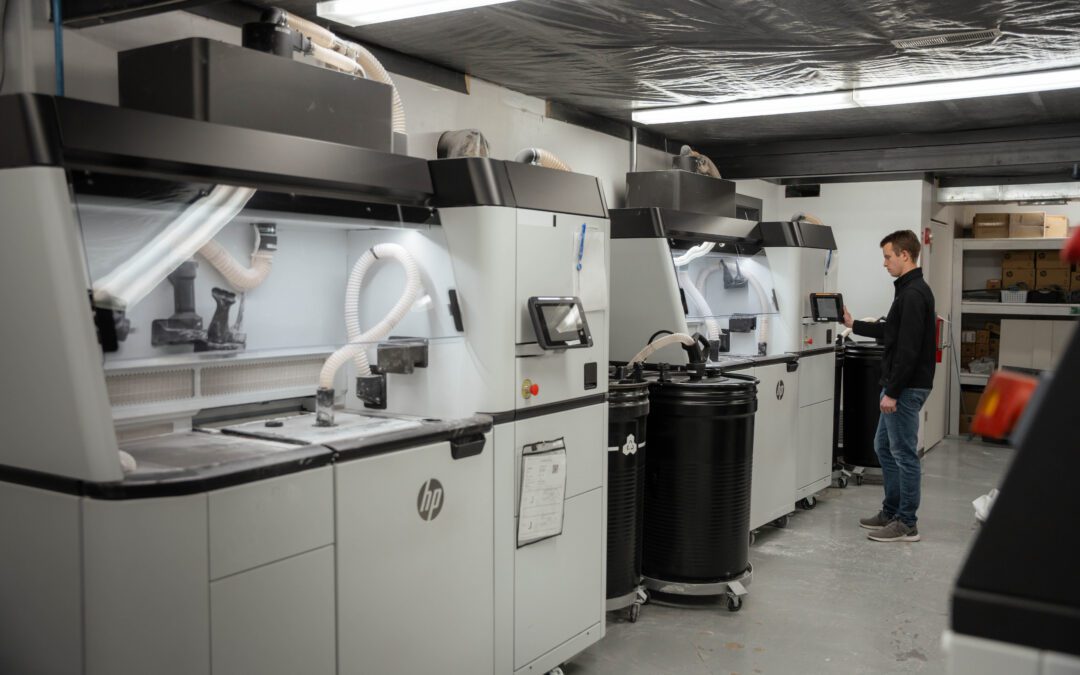
Choosing between the HP MJF 1200 and the Formlabs Fuse X1 is not a simple spec-sheet exercise. Both machines produce durable nylon parts for prototyping and end-use production, but they approach the job differently, and the better choice depends on how you print, how many parts you need, and how much of your team’s time the process takes.
This guide compares the two systems on build volume, cycle time, material utilization, additional costs, labor and automation, and thermal management, so you can judge the real investment rather than just the sticker price.
QUICK COMPARISON
Formlabs Fuse X1 price: $84,999
HP MJF 1200 price: $60,000
Technology: The Fuse X1 uses selective laser sintering (SLS). The MJF 1200 uses Multi Jet Fusion, which applies fusing and detailing agents and then heats the powder.
Build volume:
HP MJF 1200 3D Printer
- Build volume: 12 L3 (320 x 165 x 230 mm) (12.6 X 6.5 X 9 in)
- Print time: <12 h4
- HP 3D HR PA 12 by Evonik – up to 80% reusability
Formlabs Fuse X1
- Build Volume: 330 x 330 x 565 mm 13.0 x 13.0 x 22.2 in
- Print time: <24 h
Strengths: The Fuse X1 offers larger parts and thermal consistency. The MJF 1200 offers a lower entry cost and a bundled workflow.
WHAT IS INCLUDED IN THE PRICE?
The headline price rarely tells the whole story, so start with what comes in the box.
The HP MJF 1200 package includes the printer along with the workflow components needed to start producing: a Material Management System, a Natural Cooling Unit, two Material Tanks, and Magics Print for HP software. A team can move toward production without immediately budgeting for essential peripherals.
The Formlabs Fuse X1 carries a higher base price of $84,999. Confirm which post-processing and powder handling equipment is included in your configuration, and which items are sold separately, since this changes the true cost of getting started.
BUILD VOLUME
Build volume determines what you can make and how many parts fit in a single job.
The Formlabs Fuse X1 has a larger Z-axis, so it can produce taller parts in one piece. The HP MJF 1200 has a smaller chamber height, so oversized parts may need to be split in two, printed separately, and joined afterward. Splitting adds design work, assembly time, and a potential weak point at the joint.
If your work includes long housings, ducts, tubes, or large functional prototypes, the Fuse X1 gives you more freedom. If your parts are small to medium and you mostly print batches, the MJF 1200’s chamber may be entirely adequate.
WHAT IS PACKING DENSITY?
Packing density is the percentage of the build chamber’s volume that is filled with parts. Powder bed fusion needs no support structures, so parts can be nested in three dimensions, and the more efficiently you nest them, the more parts you get from each print.
Higher packing density lowers cost per part, because the fixed time and energy of each build are spread across more parts. It also increases output per operator hour, since you load, unload, and clean fewer builds for the same quantity. When comparing machines, look at realistic packing density for your own part geometries, not only the theoretical maximum volume.
CYCLE TIME
Cycle time includes more than printing. It covers pre-heating, printing, cooling, unpacking, and preparing the chamber for the next job.
Cooling is often the hidden bottleneck. The MJF 1200 uses a Natural Cooling Unit, which lets a build cool outside the printer so the machine can start another job instead of sitting idle. The Fuse X1’s approach to heat management affects both part quality and how quickly jobs turn around. [Insert verified print and cooling times for a typical full build on each machine.]
For a fair comparison, measure the full cycle from job start to parts in hand, not just printing time.
MATERIAL UTILIZATION
Powder is one of the largest recurring costs, so how much of it becomes parts matters. In powder bed fusion, unsintered powder is partly reused, and a portion is replaced with fresh material on every build. Compare the refresh rates and powder reuse each system achieves with your preferred materials [insert verified refresh rates].
Material utilization ties directly to packing density. A well-packed build wastes less powder per part and lowers unit cost, so the machine that packs more efficiently can save more money over time than the one with the lower hardware price.
FUSE X1’S SUPERIOR THERMAL MANAGEMENT
Thermal management is one of the Fuse X1’s strongest advantages. Consistent temperature across the build chamber leads to more uniform sintering, which supports repeatable mechanical properties, better dimensional accuracy, and fewer failed or warped parts, especially in tall builds that use the larger Z-axis.
For production work, repeatability matters as much as speed. If every part in a batch needs to behave the same way, tight thermal control can reduce scrap, rework, and quality checks.
LABOR AND AUTOMATION
Machine time is only part of the picture. Operators load powder, set up jobs, unpack builds, clean parts, and handle post-processing. A system that cuts these hands-on steps frees your team for higher-value work.
On the HP side, the Material Management System and Natural Cooling Unit are designed to streamline powder handling and keep the printer running between jobs. On the Formlabs side, consider how the Fuse ecosystem fits your workflow for powder handling, depowdering, and surface finishing.
Ease of use also differs by scale. For an individual or small team running a single machine, a simple, self-contained workflow often matters most. For a fleet, consistency, material handling, and job queueing across several machines become the deciding factors.
ADDITIONAL COSTS TO PLAN FOR
Beyond the purchase price, budget for:
Powder and material refresh
Post-processing equipment such as depowdering stations and media blasting
Software and licensing
Facility requirements including space, ventilation, power, and climate control
Service contracts and consumables
Operator training and labor time
These ongoing expenses can easily outweigh a price gap of roughly $25,000 between two machines.
HARDWARE PRICE DOES NOT EQUAL TOTAL INVESTMENT
A $60,000 printer and an $84,999 printer are not simply $24,999 apart in practice. Once bundled components, material use, cycle time, labor, and downtime are counted, the cheaper machine can cost more per part, or the more expensive one can pay for itself faster. Cost per part under realistic conditions is a better measure than purchase price.
MULTIPLE MACHINES OFFER FLEXIBILITY AND REDUNDANCY
A single machine with a large chamber concentrates capacity and risk in the same unit. More small machines, on the other hand, allow a form of redundancy: if one platform is stopped, the others can continue to produce.
Because the MJF 1200 has a lower entry price, a business could potentially run more than one for the cost of a single higher-priced system. That allows different materials or priorities to run in parallel, capacity to scale gradually, and deadlines to stay safe when something goes wrong. The trade-off is more machines to maintain and a larger footprint.
FREQUENTLY ASKED QUESTIONS
Which is cheaper, the HP MJF 1200 or the Formlabs Fuse X1?
The HP MJF 1200 has the lower hardware price at $60,000, compared with $84,999 for the Fuse X1. It also includes a Material Management System, a Natural Cooling Unit, two Material Tanks, and Magics Print for HP software. Total cost depends on material use, labor, and cycle time.
Which printer can make larger parts?
The Formlabs Fuse X1 has a larger Z-axis and can produce taller parts in one piece. The HP MJF 1200 may require oversized parts to be split in two and joined afterward.
What is packing density in 3D printing?
Packing density is the percentage of the build chamber’s volume filled with parts. Higher packing density lowers cost per part and increases output per operator hour.
Why does thermal management matter?
Consistent temperature across the build chamber produces more uniform sintering, which supports repeatable mechanical properties and fewer warped or failed parts.
Is it better to buy one large machine or several smaller ones?
A single large machine concentrates capacity and risk in one unit. Multiple smaller machines provide redundancy, because the others can keep producing if one stops.
THE VERDICT
The Formlabs Fuse X1 suits operations that need larger one-piece parts and strong thermal consistency, and want to avoid splitting and assembling oversized designs.
The HP MJF 1200 suits operations that want a lower entry price, a bundled workflow with the essential components included, and the option of a multi-machine setup for flexibility and redundancy.
The right answer comes down to part sizes, monthly volume, packing density, labor rates, and tolerance for downtime.