
Why 3D Scanner Selection Matters for Manufacturing
Choosing the right 3D scanner impacts your reverse engineering accuracy. It affects quality control workflows. The wrong choice wastes time and money.
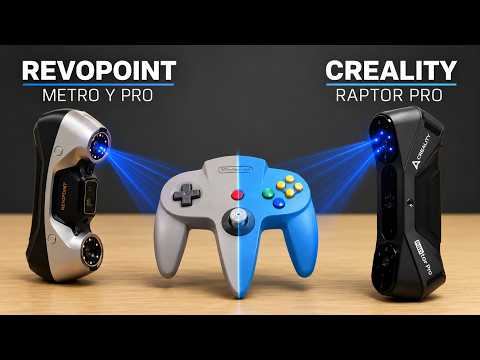
Engineering-focused YouTube channel CNC Kitchen recently tested two laser-line 3D scanners. Their hands-on 3D scanner comparison reveals important differences for industrial users.
Modern scanners promise impressive specs on paper. Real-world performance tells a different story. Understanding these gaps helps procurement teams make smarter decisions.
Key Performance Factors in Industrial Scanning
Accuracy specifications don’t tell the whole story. Surface finish quality matters just as much. So does scanning speed for production environments.
Accuracy vs. Resolution
Many buyers confuse accuracy with resolution. Resolution describes point spacing in the scan. Accuracy measures how close those points are to reality.
A high-resolution scan can still be inaccurate. Industrial applications need both. Quality control especially demands verified accuracy numbers.
Surface Type Challenges
Shiny and dark surfaces challenge every scanner. Some handle these better than others. Consider your typical part materials when selecting equipment.
- Glossy plastics require anti-reflective spray or advanced sensors
- Black parts absorb laser light, reducing data capture
- Complex geometries need multiple scan angles
- Thin features may disappear in noisy data
Software Integration for Manufacturing Workflows
Hardware means nothing without capable software. Processing speed affects daily productivity. Export formats determine downstream compatibility.
Mesh Quality and Cleanup
Raw scan data needs processing before use. Better software reduces manual cleanup time. This matters when scanning dozens of parts weekly.
Look for automatic hole filling and noise reduction. Mesh optimization tools save CAD team hours. These features justify higher equipment costs.
CAD Compatibility Considerations
Your team likely uses specific CAD platforms. Ensure scanner software exports compatible formats. STEP and IGES remain industry standards for solid models.
- STL works for visual reference and 3D printing
- OBJ preserves color data for documentation
- Native CAD formats speed up design integration
- Point cloud exports suit inspection software
Reverse Engineering Applications
Scanning enables rapid reverse engineering of legacy parts. This supports additive manufacturing workflows directly. Scanned data becomes printable geometry quickly.
When accuracy meets your tolerance requirements, scanned parts work well. Multi Jet Fusion and Selective Laser Sintering both accept scanned geometry. The key is validating dimensional accuracy first.
Quality Control Integration
Compare scanned parts against original CAD models. Deviation maps show manufacturing consistency. This closes the loop on production quality.
Regular scanning catches drift before it causes failures. Inspection becomes faster than traditional CMM methods. Many manufacturers combine both approaches strategically.
Making the Right Investment Decision
Entry-level scanners suit occasional reverse engineering needs. High-volume inspection demands professional-grade equipment. Match capabilities to your actual use case.
Consider total cost of ownership beyond purchase price. Training time, software subscriptions, and maintenance add up. Faster workflows often justify premium equipment.
When to Partner Instead
Not every facility needs scanning equipment in-house. Service bureaus offer scanning alongside manufacturing capabilities. This approach reduces capital investment while maintaining access.
JawsTec provides complete digital manufacturing services for teams needing scanned parts produced quickly. Request a quote to discuss your reverse engineering and production needs together.
Practical Takeaways
The CNC Kitchen comparison highlights real performance gaps between scanners. Specifications alone don’t predict results. Hands-on testing with your actual parts matters most.
Focus on your specific materials and geometries. Evaluate software workflows alongside hardware specs. Consider whether ownership or partnership serves you better.
Understanding why orientation matters in 3D printing helps maximize scanned part quality. Proper build orientation reduces post-processing needs significantly.
Sources
Source: I Tested Two 3D Scanners: One Is Simply Better! by CNC Kitchen (YouTube) — https://www.youtube.com/watch?v=6Pe7mMFp9Go