
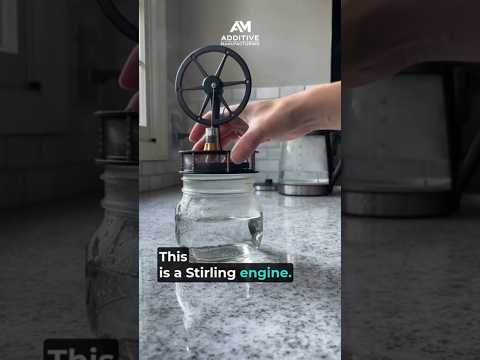
Stirling engine 3D printing is enabling a new generation of industrial power systems. Hyliion’s Karno Power Module uses additive manufacturing to create fuel-flexible generators for off-grid applications.
What Is the Karno Power Module?
The Karno is an industrial generator designed for large facilities. It powers manufacturing plants, big-box stores, and other buildings without grid connection. The system runs on almost any fuel source available on site.
AM Media’s The Cool Parts Show recently featured this innovative system. The Karno uses Stirling engine technology rather than traditional combustion engines. This external combustion design offers unique advantages for industrial power generation.
Why Stirling Engines Need Additive Manufacturing
Stirling engines work by heating and cooling gas in sealed chambers. The temperature differential drives pistons to generate power. These engines require complex internal geometries that traditional manufacturing struggles to produce.
Additive manufacturing solves several critical design challenges:
- Complex heat exchanger channels impossible to machine conventionally
- Optimized thermal pathways for maximum efficiency
- Reduced part count through consolidated assemblies
- Faster iteration during development cycles
The Karno’s heat exchangers benefit most from AM capabilities. These components need intricate internal passages for effective heat transfer. Metal 3D printing processes create geometries that would require multiple brazed parts otherwise.
Fuel Flexibility Changes Industrial Power
External combustion engines burn fuel outside the working chambers. This separation allows the Karno to use diverse fuel sources. Natural gas, propane, hydrogen, and biogas all work with the same hardware.
For manufacturers, this flexibility offers significant advantages:
- Use waste gases from industrial processes
- Switch fuels based on availability and cost
- Transition to hydrogen without equipment changes
- Operate in remote locations with local fuel sources
The off-grid capability matters for facilities in areas with unreliable power. Manufacturing operations need consistent electricity regardless of grid conditions.
Design Lessons for AM Engineers
Hyliion’s approach demonstrates key principles for designing AM parts. They targeted components where additive manufacturing provides clear advantages. Heat exchangers with complex internal channels are ideal candidates.
The company didn’t 3D print everything. They focused AM on parts that benefit most from geometric freedom. This selective approach maximizes value while controlling costs. Understanding how to choose the right material for each application is critical.
Part consolidation reduced assembly complexity significantly. Fewer parts means fewer potential failure points. It also simplifies supply chains and inventory management.
Procurement Considerations for AM Power Components
Teams evaluating AM for power generation equipment should consider several factors. High-temperature metals require specialized printing capabilities. Post-processing and heat treatment affect final properties.
Quality control matters especially for pressure-containing components. Consistent material properties throughout heat exchanger walls ensure safe operation. Working with experienced AM partners helps navigate these requirements.
JawsTec offers instant quoting for industrial additive manufacturing projects. Our team can help evaluate whether your power system components are good candidates for AM.
The Future of AM in Energy Systems
The Karno represents broader trends in energy equipment design. Efficiency improvements often require complex geometries. Additive manufacturing removes traditional design constraints.
Engineers should watch this space for emerging applications. Fuel cells, turbines, and heat recovery systems all benefit from AM capabilities. The technology enables designs that weren’t previously manufacturable.
Understanding why orientation matters helps engineers design better AM components. Build direction affects surface finish and mechanical properties in critical applications.