
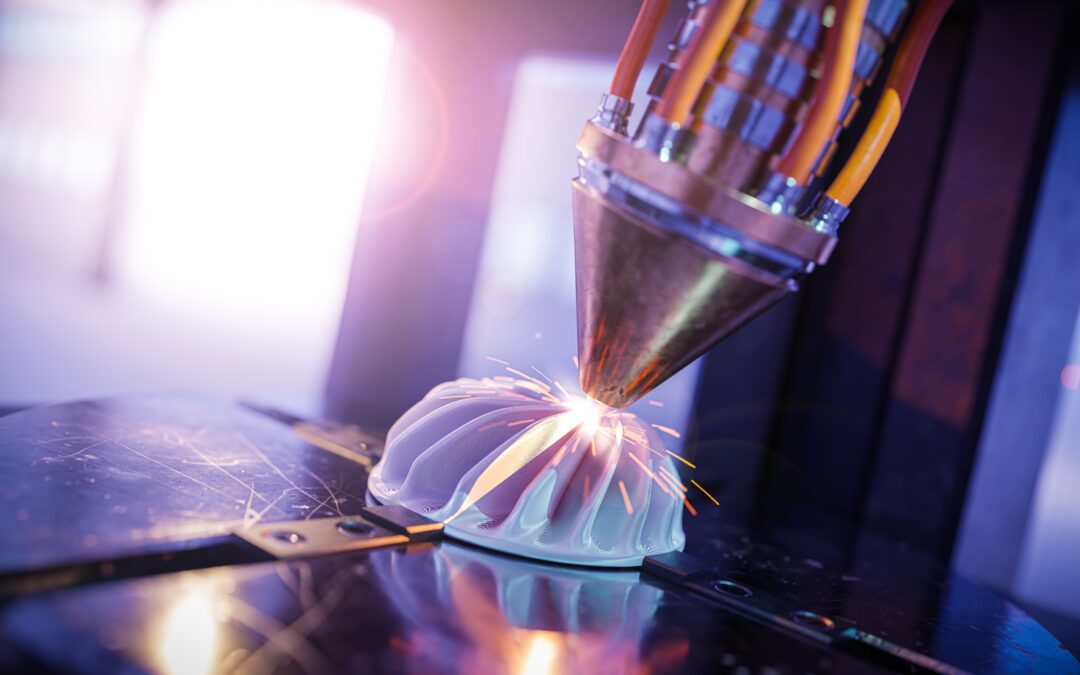
Most people are familiar with the wide range of plastic 3D printing options available today. Industrial-grade polymers, durable nylons, and flexible materials are commonly used to create prototypes and end-use parts. What many still don’t realize is that metal 3D printing is now a proven, production-ready manufacturing method.
Metal 3D printing enables the creation of complex, high-strength metal parts that are difficult or impossible to produce using traditional manufacturing. By building parts layer by layer, engineers can achieve advanced geometries, internal channels, and optimized structures without the constraints of machining or casting.
What Is Metal 3D Printing?
Metal 3D printing, also known as metal additive manufacturing, is a process that builds fully dense metal parts by selectively fusing metal material layer by layer based on a digital CAD model.
There are several metal 3D printing technologies, but one of the most common industrial methods is Selective Laser Melting (SLM). SLM belongs to the powder bed fusion family of processes, where a high-powered laser fully melts metal powder to create solid metal parts.
SLM is sometimes grouped with or referred to as Direct Metal Laser Sintering (DMLS). While the terms are often used interchangeably, both processes produce nearly fully dense metal components suitable for functional use.
How SLM Works
- A thin layer of metal powder is spread across the build plate
- A laser selectively melts the powder according to the part geometry
- The build platform lowers, and the process repeats layer by layer
- The result is a solid metal part with high mechanical strength
Unlike plastic powder bed processes such as Selective Laser Sintering (SLS) or HP Multi Jet Fusion (MJF), SLM operates at much higher temperatures and requires support structures.
Why Are Supports Required in Metal 3D Printing?
Support structures in metal 3D printing serve several critical purposes:
- Provide structural support for overhangs and complex features during printing
- Anchor the part to the build plate to reduce distortion and warping
- Act as heat sinks, helping manage thermal stress and control cooling
After printing, supports are removed through machining or post-processing.
What Is Possible with Metal 3D Printing?
Metal 3D printing opens the door to designs that traditional manufacturing struggles to achieve.
Key Benefits of Metal 3D Printing
High Strength and Durability
Metal 3D printed parts can match or exceed the mechanical properties of wrought or cast materials, depending on the alloy and post-processing.
Complex Geometries
Internal channels, lattice structures, lightweight designs, and conformal cooling paths can be produced without additional tooling.
Part Consolidation
Multiple components can often be combined into a single printed part, reducing assembly time, failure points, and overall cost.
Rapid Iteration
Designs can be modified and reprinted quickly, making metal 3D printing ideal for development and low-volume production.
Limitations of Metal 3D Printing
While powerful, metal additive manufacturing is not always the best solution for every application.
Higher Cost
Metal 3D printing is typically more expensive than plastic printing or traditional methods, especially for large volumes.
Build Size Constraints
Part size is limited by machine build volume and the need for precise environmental control during printing.
Post-Processing Requirements
Most metal printed parts require secondary steps such as support removal, heat treatment, and surface finishing.
Common Uses for Metal 3D Printing
Metal 3D printing is commonly used for production-grade prototyping and low-volume manufacturing. These parts are often fully functional and suitable for real-world testing or end-use applications.
Typical use cases include:
- Functional prototypes that closely match final production parts
- Low-volume or bridge production without tooling investment
- Complex components with internal features or weight reduction
- Aerospace, automotive, robotics, and industrial equipment parts
Is Metal 3D Printing Right for Your Application?
Metal 3D printing is best suited for parts where performance, complexity, or speed outweigh the cost of traditional manufacturing. When designed correctly, it enables faster development cycles and highly optimized metal components that would otherwise be impractical to produce.
Metal 3D Printing at JawsTec
JawsTec offers professional metal 3D printing services for customers who need functional, production-ready parts. Our current capabilities focus on powder bed metal printing, allowing us to produce complex geometries with high strength and tight tolerances. Our team works closely with customers to review designs, recommend manufacturable features, and ensure parts are optimized for metal 3D printing from the start.