
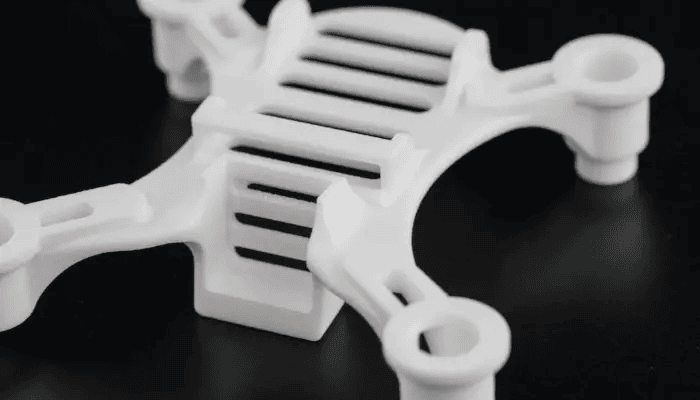
PA2200 is a polyamide 12 (nylon 12) powder developed by EOS for selective laser sintering (SLS). It is one of the most established materials in industrial additive manufacturing and is often used for production parts rather than just prototypes. It prints white by default, and finished parts can be dyed, polished, or vapor smoothed. This guide covers nylon PA2200 material properties, how to read the PA2200 data sheet, which materials are compatible with PA2200, and which companies make PA2200 and similar powders. If you want to see the material in action, JawsTec offers SLS PA2200 as part of its nylon 3D printing service.
Nylon PA2200 Material Properties
PA2200 is valued for its balanced strength, toughness, and accuracy. Parts are impact-resistant, lightweight, and dimensionally stable over time, which is why they work as functional end-use components. The powder is finer than many standard PA 12 powders, so it resolves small features well and holds tight tolerances. It is also compliant with ISO 10993-1 and USP Class VI biocompatibility standards, so it is used in medical, orthopedic, and, with proper processing, food-contact applications. See how this applies to medical 3D printing.
It has some drawbacks. The as-printed surface is slightly rough and grainy, which polishing or vapor smoothing can fix, but it adds an extra step. Prolonged UV exposure can discolor the material, so outdoor parts need a coating or a UV-stable alternative. It also costs more than standard PA 12 powders.
PA2200 Data Sheet: What to Look For
The PA2200 data sheet is published by EOS, and a printer or service bureau may also provide its own version for a specific machine and process setup. Our 3D printing capabilities page includes a Nylon SLS PA 2200 data sheet along with design guidelines, build volumes, and tolerances. The figures below are typical published values for laser-sintered parts. They vary by data sheet revision, build orientation, and machine settings, so check the current official document before using them in a design calculation or specification.
- Tensile modulus: roughly 1,650 to 1,700 MPa, which indicates a stiff but not brittle material.
- Tensile strength: about 48 MPa.
- Elongation at break: typically, 18 to 24 percent in the XY plane, which gives PA2200 its toughness.
- Flexural modulus: around 1,500 MPa.
- Notched Charpy impact strength: approximately 4 to 5 kJ/m².
- Part density: about 0.93 g/cm³.
- Average powder particle size: around 55 to 60 microns.
- Melting point: about 176 °C.
- Vicat softening temperature: roughly 163 °C, so parts hold their shape in moderately warm environments.
The data sheet also lists powder properties, the recommended refresh ratio for recycled powder, and biocompatibility statements. When comparing PA2200 to other powders, compare values from the same test standards and the same build orientation. SLS parts are slightly anisotropic, and Z-direction values are usually lower than XY values.
For dimensional planning, JawsTec lists tolerances for SLS and MJF nylon of ±0.300 mm (±0.012″) in X and Y, and ±0.400 mm (±0.015″) in Z. SLS prints are produced at a 120-micron layer thickness.
PA 2200 vs. PA 12: What’s the Difference?
Both are nylon-based SLS powders. Both offer good strength and flexibility. The difference is resolution and mechanical performance.
PA 2200 uses finer powder, which translates to better surface detail and more accurate parts. If you’re printing prototypes and standard PA 12 is doing the job, it’s fine. If you’re printing production parts where tolerances and surface quality matter, PA 2200 is the better call. Results still depend on the machine and process, so request a sample or the supplier’s data sheet when the application is critical. You can also compare options on our nylon 3D printing service page, which covers SLS PA2200, SLS PA12, MJF PA12, and MJF PA11.
Design Guidelines for PA2200
Standard walls should be at least 1.0 mm thick, and load-bearing walls should be 1.5 to 2.0 mm. Moving or interlocking parts need 0.3 to 0.5 mm of clearance to avoid fusing. Engraved and embossed text should be at least 1.0 mm deep or tall to stay readable. For machine-specific rules, see the SLS design guidelines.
What Materials Are Compatible with PA2200 for 3D Printing?
Compatibility has three meanings in practice: other powders that run on the same equipment, powder mixing, and post-processing materials.
Same-equipment materials. PA2200 runs on EOS SLS systems such as the FORMIGA P and EOS P series machines. Related EOS materials that use the same process include glass-filled and mineral-filled polyamide 12 variants, carbon-fiber-filled polyamides, flame-retardant PA 12 grades, black-pigmented PA 12 grades, and polyamide 11 powders for more ductile parts. These are separate materials with their own parameter sets, and a machine should be fully cleaned and re-parameterized before switching between them.
Powder mixing. Unsintered SLS powder can be reused, but it ages with each build, so it is blended with fresh powder at a controlled refresh ratio. Mixing PA2200 with a different manufacturer’s PA 12 or with another grade is not recommended unless the supplier has validated the blend, because differences in particle size and thermal behavior can cause defects and inconsistent properties.
Post-processing materials. PA2200 works well with tumbling, media blasting, polishing, vapor smoothing, and dyeing, which is how colored parts are made from the natural white material. Coatings and paints can add UV resistance or change the finish. Parts can be joined with common adhesives such as cyanoacrylate and epoxy, and they accept threaded metal inserts and machined features.
Which Companies Manufacture PA2200-Based 3D Printing Materials?
PA2200 is an EOS product name, so EOS GmbH is the original manufacturer of the powder sold under that name. Many other companies make polyamide 12 powders for SLS or similar processes, including Evonik, 3D Systems (DuraForm PA), HP (PA 12 for Multi Jet Fusion), Formlabs (Nylon 12 for the Fuse series), Farsoon, Sintratec, Sinterit, and Stratasys. These are comparable materials, but they are not PA2200 itself.
PA2200 is a strong material. Its parts are tough, impact-resistant, and dimensionally stable, and the finer powder holds detail and tight tolerances. Because those qualities depend on the powder, the printer, and the process behind each build, PA2200 is only as good as the source it comes from. A reliable source uses genuine material, runs well-maintained industrial SLS machines, and controls powder quality from build to build, so the parts you receive match the properties you designed around.
JawsTec prints PA2200 on industrial EOS SLS machines with an average lead time of 4 to 5 business days. Finishing options include dyeing, polishing, and vapor smoothing, so you can get colored parts or a smoother surface without coordinating a second vendor. Learn more about our SLS 3D printing service or browse all 3D printing materials.
Common Applications
PA2200 is used for functional prototypes, fit and assembly testing, clips, brackets, housings, and interior automotive parts. It also appears in medical and orthopedic devices, eyewear frames, sports gear, and lightweight consumer enclosures. Explore related industries: rapid prototyping, automotive 3D printing, and consumer products 3D printing.
PA2200 FAQ
What is the PA2200 data sheet?
It is the technical document from EOS listing mechanical, thermal, and powder properties for PA2200. Nylon SLS PA 2200 data sheet.
What are the main nylon PA2200 material properties?
High toughness, impact resistance, dimensional stability, fine detail, and ISO 10993-1 and USP Class VI biocompatibility compliance.
Does PA2200 change color over time?
Yes. Raw PA2200 can yellow with prolonged UV exposure, so outdoor parts should be coated or dyed.
Can I get PA2200 parts quickly?
Yes. Average lead time at JawsTec is 4 to 5 business days, and rush production is available for SLS PA2200.
Get PA2200 Parts at JawsTec
JawsTec prints PA2200 on industrial SLS machines and offers dyeing, polishing, and vapor smoothing. Upload your file to the Instant Quote Engine to get pricing and lead time, or check our FAQ for file types, rush options, and shipping.
Hi Team,
I hope you’re doing well.
We are currently working with our customer (Department of the Navy) on an upcoming project and would appreciate your support with pricing information.
Project Name: Polyamide Powder
The details are as follows:
(Item No 1): PA 2200 Polyamide Powder 480KG PART# 9012-0014
Quantity: 88
Unit: EA
Description:
PA 2200 Polyamide Powder 480KG
PART# 9012-0014 88 EA
002 SHIPPING 1 EA
Proposal Deadline: Apr 30, 2026
Delivery: U.S. Naval Research Laboratory 4555 Overlook Avenue, S.W. Bldg. 49 Washington, DC 20375
Please note that we are looking for the most competitive pricing available. Products must be Made in the USA or TAA compliant.
Additionally, please include the following information in your quotation:
Delivery schedule / lead time
Payment terms and conditions
Validity period of the quotation
Shipping, handling, and applicable taxes (if any)
Best Regards,
Please reach us to [email protected] for information on pricing and quotes.