
What If Metal Printing Didn’t Need Loose Powder?
Metal 3D printing offers incredible design freedom. But loose metal powder creates serious challenges. Handling, storage, and safety concerns slow adoption across many industries.
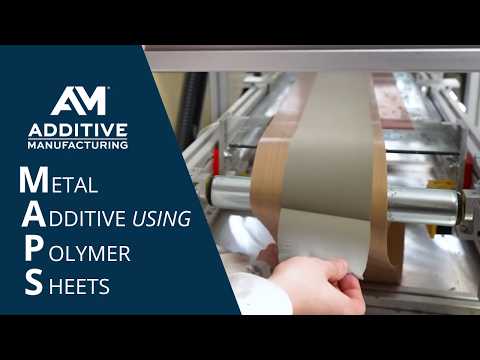
A new approach called metal polymer sheets could change that equation. Addicoat, a spinout from Trinity College Dublin, developed Metal Additive Using Polymer Sheets (MAPS) technology. It encapsulates metal powder within thin polymer films.
This innovation addresses key pain points for manufacturers considering metal additive manufacturing.
How MAPS Technology Works
Traditional powder bed fusion spreads loose metal powder across a build platform. Each layer requires precise powder distribution. The process demands controlled environments and strict safety protocols.
MAPS takes a different path. Metal particles get embedded within polymer sheet material. These sheets stack layer by layer during the build process.
The laser still sinters or melts the metal particles together. But the polymer acts as a carrier and binder. It burns away during processing, leaving solid metal parts behind.
Key Advantages for Manufacturing Teams
This approach offers several practical benefits for industrial applications:
- Reduced explosion and inhalation hazards from loose metal powder
- Simplified material handling and storage requirements
- Potentially lower facility infrastructure costs
- Easier material changeovers between different metal alloys
- More consistent layer thickness across the build
What This Means for Procurement Teams
Metal powder management adds significant cost to additive manufacturing operations. Specialized HVAC systems, safety training, and handling equipment all factor into total cost of ownership.
MAPS technology could reduce these overhead requirements. Sheets are easier to inventory and transport than reactive metal powders. This simplifies supply chain logistics considerably.
The technology is still emerging from Addicoat’s development labs. Commercial availability timelines remain unclear. But the potential for safer, simpler metal printing deserves attention.
Comparing to Current Metal AM Options
Today’s metal 3D printing processes include powder bed fusion, directed energy deposition, and binder jetting. Each has tradeoffs around speed, resolution, and material properties.
MAPS doesn’t eliminate the fundamental physics of metal sintering. Parts still require similar post-processing steps. Heat treatment and surface finishing remain necessary for most applications.
The main differentiation lies in pre-processing and safety considerations. For facilities without existing powder handling infrastructure, this could lower barriers to entry.
Design Considerations Still Apply
Engineers shouldn’t assume MAPS eliminates all metal AM constraints. Part orientation, support structures, and thermal management still matter. Understanding why orientation matters in 3D printing remains essential.
The technology may introduce its own design rules. Sheet thickness could affect minimum feature sizes. Layer interfaces might behave differently than traditional powder beds.
Questions to Ask Before Adopting New Processes
When evaluating emerging technologies like MAPS, consider these factors:
- What metal alloys are available in sheet format?
- How do mechanical properties compare to powder-based parts?
- What certifications exist for aerospace or medical applications?
- What is the total cost per part including materials?
The Path Forward for Metal Additive
Innovation in metal 3D printing continues at a rapid pace. Technologies like MAPS show the industry is actively solving real manufacturing challenges. Safety and accessibility improvements benefit everyone.
For teams exploring metal additive manufacturing today, established processes still deliver proven results. JawsTec offers multiple production-ready options for metal and polymer parts. Request a quote to discuss your specific application requirements.
Keep watching developments like MAPS technology. The metal AM landscape will look quite different in five years.
Sources
Source: Could These Metal-Polymer Sheets Replace the Powder Bed? by AM Media — The Cool Parts Show (YouTube) — https://www.youtube.com/watch?v=A3owbI3NEsY