
What Is Continuous Fiber 3D Printing?
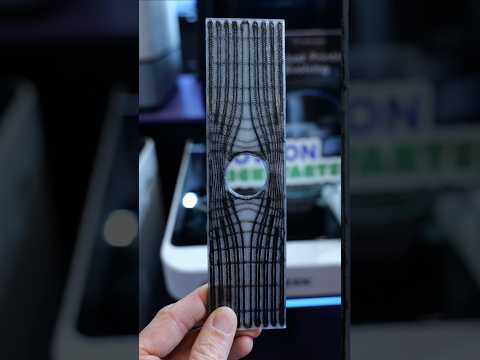
Continuous fiber 3D printing embeds long strands of reinforcing material directly into thermoplastic parts. Unlike chopped fiber composites, continuous strands run unbroken through the print. This creates parts with strength properties approaching aluminum.
At Formnext 2025, engineering YouTuber CNC Kitchen explored the FibreSeeker 3 system. This printer demonstrates how continuous fiber technology is becoming more accessible. The machine weaves carbon fiber strands into nylon during the printing process.
How the Technology Works
The printer uses a dual-material approach for continuous fiber 3D printing. Standard nylon filament forms the bulk of each part. A secondary system feeds continuous carbon fiber into specific layers.
The fiber placement follows programmed paths within each layer. Engineers can specify exactly where reinforcement is needed. This selective placement optimizes strength-to-weight ratios.
Key Technical Features
- Continuous carbon fiber embedded in nylon matrix
- Selective fiber placement for optimized strength
- Parts approach aluminum in specific load directions
- Reduced weight compared to metal alternatives
Industrial Applications and Considerations
Continuous fiber parts excel in specific loading scenarios. Tensile and bending loads parallel to fiber direction show dramatic strength gains. Engineers must design parts with fiber orientation in mind.
Understanding why orientation matters in 3D printing becomes critical with this technology. Fiber direction determines where strength concentrates. Poor orientation planning wastes the technology’s potential.
When Continuous Fiber Makes Sense
- Weight-critical structural components
- Replacing machined aluminum brackets
- Custom tooling and fixtures
- Low-volume production parts
- Prototypes requiring near-production strength
Comparing Manufacturing Approaches
Continuous fiber printing fills a gap between standard plastic parts and metal. Traditional FDM parts lack structural strength for demanding applications. Metal printing or machining adds significant cost and lead time.
For many applications, choosing the strongest 3D printing material depends on your specific requirements. Continuous fiber excels at directional loads. Isotropic strength needs may require different approaches.
Design Considerations for Engineers
Designing for continuous fiber requires understanding its anisotropic nature. Parts are strongest along fiber paths. Perpendicular loads see standard nylon properties only.
Fiber placement planning integrates with standard DFM principles. Wall thickness, layer adhesion, and fiber path continuity all affect performance. Simulation tools help predict actual part behavior.
Material Selection Context
JawsTec offers multiple industrial printing technologies for different requirements. Selective laser sintering provides excellent isotropic nylon parts. Metal 3D printing handles extreme temperature and load requirements.
Each technology serves specific engineering needs. Continuous fiber fills the high-strength, low-weight niche effectively.
Evaluating This Technology for Your Projects
Procurement teams should consider total cost of ownership. Material costs run higher than standard thermoplastics. However, part consolidation and weight savings often justify the investment.
For projects requiring structural polymer parts, request samples and test data. Compare against your specific load cases. Real-world testing validates whether this approach fits your application.
Need help selecting the right manufacturing approach for your next project? Get a quote from JawsTec to explore your options across multiple industrial 3D printing technologies.
Sources
Source: Checking out the FibreSeeker 3 at Formnext 2025 #3dprinting #carbonfiber #ad by CNC Kitchen (YouTube) — https://www.youtube.com/watch?v=WavZQoTc6W0