
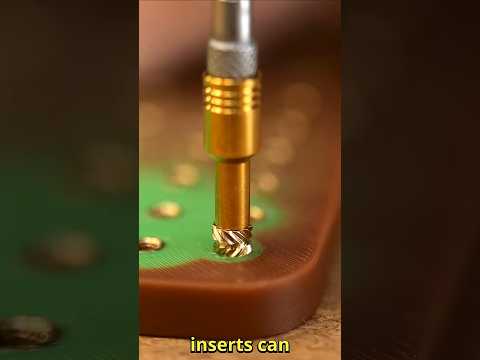
Why Heat-Set Inserts Matter for Production Parts
Threaded connections in 3D printed parts often fail under repeated use. Heat-set inserts solve this problem by providing durable metal threads in polymer components. For engineers and manufacturers, mastering this post-processing technique improves part reliability significantly.
CNC Kitchen, a popular engineering-focused YouTube channel, recently tested battery-powered soldering irons for installing heat-set inserts. The findings offer practical insights for production environments.
Tool Selection for Industrial Applications
Traditional corded soldering stations work well but limit mobility. Battery-powered alternatives now offer sufficient power for insert installation. This matters for production floors and field assembly operations.
Key factors for tool selection include:
- Consistent temperature control for uniform installations
- Appropriate tip geometry matching insert size
- Sufficient thermal mass to prevent cooling during insertion
- Ergonomic design for repetitive operations
Specialized tips designed specifically for heat-set inserts outperform standard soldering tips. These tips feature flat ends and precise diameters for clean installations.
Best Practices for Consistent Results
Proper technique ensures inserts seat correctly every time. Temperature settings depend on your base material. Nylon and PA12 parts from SLS printing typically require higher temperatures than standard thermoplastics.
Follow these installation guidelines:
- Pre-heat the insert before touching the part surface
- Apply steady downward pressure without forcing
- Stop when the insert sits flush with the surface
- Allow cooling before testing thread engagement
Rushing the process causes poor bonding. The plastic must flow completely around the insert’s knurled surface.
Hole Sizing Considerations
Correct hole diameter proves critical for pull-out strength. Undersized holes cause material displacement and surface bulging. Oversized holes reduce grip strength dramatically.
Most insert manufacturers provide recommended hole sizes. These specifications assume injection molded parts. 3D printed parts may require slight adjustments based on your process. Multi Jet Fusion and SLS parts often need hole sizes 0.1-0.2mm smaller than stated recommendations.
Material Compatibility Factors
Not all 3D printing materials accept heat-set inserts equally. Amorphous polymers like ABS work well because they soften gradually. Semi-crystalline materials like nylon require more precise temperature control.
For production parts requiring threaded fasteners, consider these material options:
- PA12: Excellent insert retention with proper technique
- PA11: Good flexibility with strong insert bonds
- TPU: Limited suitability due to material elasticity
Understanding your material properties helps predict insert performance. Check our guide on choosing the best 3D printing material for detailed comparisons.
Design Integration for Manufacturing
Smart part design simplifies insert installation. Adding counterbores provides visual alignment guides. Including draft angles around insert locations improves material flow during installation.
Wall thickness around inserts should exceed the insert diameter. Thin walls crack under installation pressure or fastener torque. This design requirement impacts overall part geometry decisions early in development.
Quality Control Measures
Production environments need consistent verification methods. Torque testing confirms proper installation. Visual inspection catches surface defects and misalignment issues.
Document your process parameters for repeatability. Temperature, dwell time, and insertion force all affect final quality.
Getting Started with Professional Results
Heat-set inserts transform 3D printed prototypes into functional production parts. The technique requires minimal equipment investment but delivers significant reliability improvements.
JawsTec provides industrial 3D printing services with parts optimized for post-processing requirements. Request a quote to discuss your threaded connection needs with our engineering team.
Sources
Source: Battery Soldering Iron vs. Heat-Set Inserts #fanttik #FanttikT1Max by CNC Kitchen (YouTube) — https://www.youtube.com/watch?v=FuIe2_s2bOs