
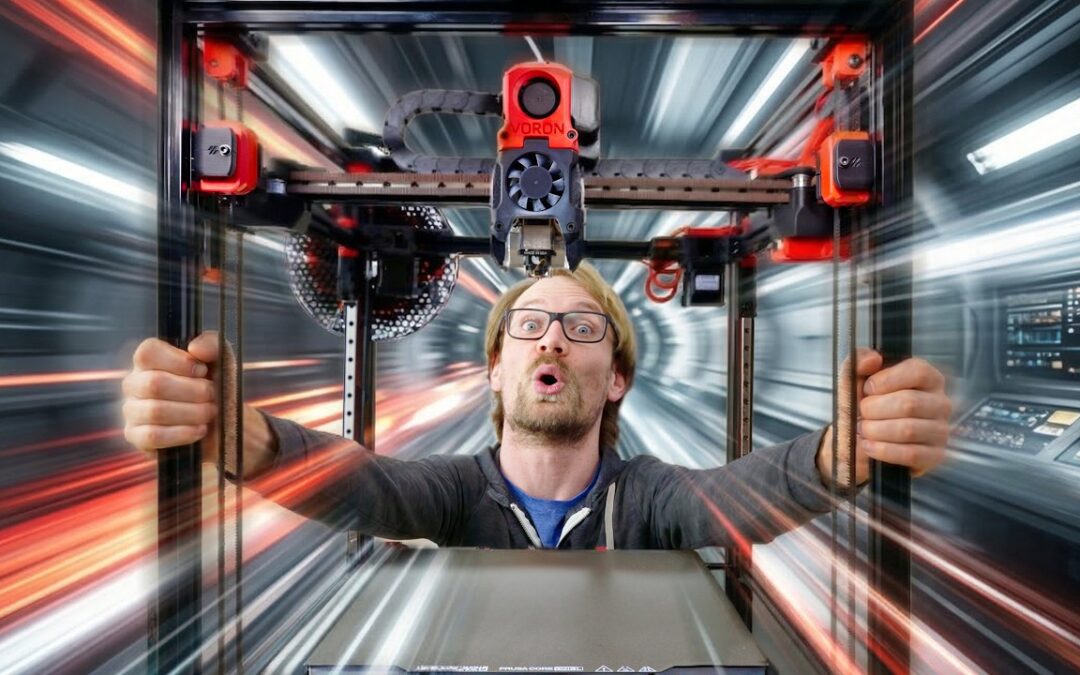
Fast 3D printers weren’t always the norm. Just a few years ago, most machines crawled at 40-60mm/s. Now budget printers hit 500mm/s or more. What changed? Thomas Sanladerer, a well-known 3D printing YouTuber with over a decade of experience, breaks down the evolution in a recent video.
The Early Days: Why Printers Were Slow
Early desktop printers had fundamental limits. Heavy print heads with direct-drive extruders meant moving a lot of mass. Weak stepper motors couldn’t accelerate quickly. The frames often flexed at higher speeds.
Slicer software made it worse. Early slicers used simple speed settings. They didn’t account for acceleration or how corners affected print quality.
Key Innovations That Changed Everything
Several breakthroughs happened almost at once. Each one removed a bottleneck:
- CoreXY kinematics: This design splits motion between two motors. Neither motor moves with the print head. Less moving mass means faster acceleration.
- Lightweight hotends: Smaller, lighter hotends reduced print head weight by half or more.
- High-flow hotends: Faster printing needs more molten plastic. New hotend designs melt filament 3-4x faster.
- Input shaping: Software that cancels vibrations lets printers move faster without ringing artifacts.
Klipper Firmware: The Game Changer
Klipper firmware moved processing from the printer’s weak controller to a more powerful computer. This enabled features like input shaping and pressure advance. Suddenly, older printers could run faster with better quality.
The open-source community drove much of this. Hobbyists shared tuning profiles and improvements freely. Manufacturers noticed.
How Manufacturers Responded
Bambu Lab launched the X1 in 2022. It shipped fast out of the box—no tinkering needed. This forced competitors to catch up. Creality, Anycubic, and others released speed-focused machines within months.
The race continues. Today’s budget printers outperform expensive machines from just three years ago.
What This Means for You
Faster printers save time. A print that took 8 hours now takes 2. But speed isn’t everything. Consider these trade-offs:
- Faster prints may need tuning for best quality
- Some materials don’t handle high speeds well
- Noise increases at higher speeds
- Wear on components may increase over time
For most hobbyists, modern fast printers are a clear win. The quality at speed has improved dramatically.
When Speed Isn’t Enough
Desktop FDM printers have limits. For parts needing tighter tolerances, isotropic strength, or production-ready finishes, industrial processes like Multi Jet Fusion offer another level. If you need parts faster than you can print them, see how ordering works at JawsTec—upload a file and get a quote in minutes.
The speed revolution made desktop 3D printing practical for more projects. Understanding how we got here helps you pick the right tool for each job.
Sources
Source: How 3D printers got FAST by Thomas Sanladerer (YouTube) — https://www.youtube.com/watch?v=ntVDsBL7VDo