
Multi Jet Fusion (MJF) vs. Selective Laser Sintering (SLS): Which Is Stronger?
3D printing offers far more variety than older machining techniques. That variety extends beyond design freedom into how a part is actually created. You can print the same part with different processes and get noticeably different results.
Multi Jet Fusion (MJF) and Selective Laser Sintering (SLS) are two of the most popular industrial methods. Both use nylon powder, both produce strong functional parts, and both are trusted in production. Both work by thermally fusing (sintering) polymer powder layer by layer, but the parts they produce differ in strength, surface finish, material options, and cost. Here’s how each process works, where each one wins, and how to choose.
What Is Multi Jet Fusion (MJF)?
MJF is an industrial 3D printing process that uses nylon powder and precision agents to build strong, functional parts layer by layer. A fusing agent is applied to the powder, which promotes the absorption of infrared light and fuses each cross-section. Because it was developed for production-level performance, MJF is commonly used for functional prototypes and end-use components that need durability and tight tolerances.
What Is Selective Laser Sintering (SLS)?
SLS uses a high-powered laser to fuse nylon or polyurethane powder into functional parts. A thin layer of polymer powder is spread across the build platform, and the laser selectively sinters the material according to the digital design file. The sequence repeats until the part is fully formed within the powder bed. Because the surrounding powder supports the part, no support structures are needed.
The Key Difference: The Heat Source
The main difference between MJF and SLS is how they deliver heat. MJF uses an ink as a fusing agent, which promotes the absorption of infrared light. SLS uses a laser to scan and fuse every cross-section.
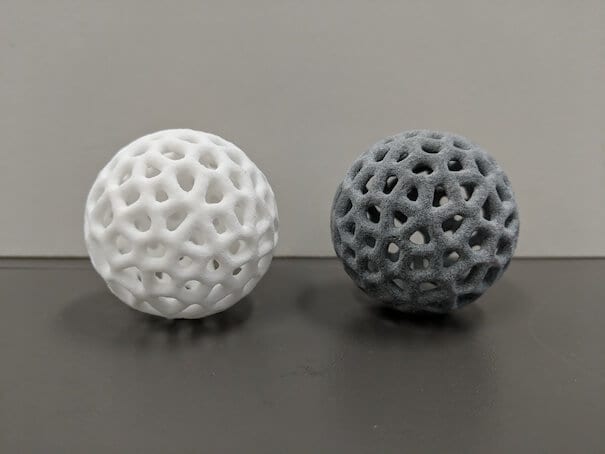
The two processes are closely related, but that difference shapes the printed part. To show how, we’ll compare two nylon materials we use at Jawstec: Black PA12 (printed with MJF) and PA2200 (printed with SLS).
Black PA12 (MJF)
Parts printed in Black PA12 have a smooth finish and tend to be stronger than SLS parts, especially in the z-direction. That makes PA12 a better choice for parts that must withstand stress up and down through the layers.
MJF also offers practical production advantages:
- Shorter cooling and post-processing times than SLS with PA2200
- Higher powder reuse: roughly 80% of the powder can be recycled, compared with about 50% for SLS with PA2200
- Slightly higher dimensional accuracy, though the difference between the two processes is small
- Access to PA12 Smooth, an engineered nylon that gives parts a better surface finish than standard MJF output
PA2200 (SLS)
PA2200 is a strong, dimensionally stable, lightweight nylon suited to end-use products across many industries. It takes dye well, which makes it useful for decorative projects. (Black PA12, by contrast, is a light grey that is dyed black in post-processing.)
SLS also has real advantages:
- A more established, better-studied process. Impact strength and creep characteristics are better understood.
- Material variety. SLS offers TPU, a flexible material ideal for applications that need softness, flex, or impact absorption, such as medical braces, robotic components, and gauges.
- Slightly lower cost. The two processes cost about the same, but SLS tends to be a touch cheaper.
MJF vs. SLS: Summary Comparison
| Multi Jet Fusion (MJF) | Selective Laser Sintering (SLS) | |
|---|---|---|
| Heat source | Fusing agent + infrared energy | Laser |
| Standout materials | PA12, PA12 Smooth | PA2200, TPU |
| Strength | Strong, especially in the z-direction | Strong, well-characterized |
| Surface finish | Smoother | Slightly rougher |
| Powder reuse | ~80% | ~50% |
| Cooling and post-processing | Shorter | Longer |
| Cost | Comparable | Comparable, slightly lower |
| Best for | Functional prototypes, aesthetics, high-volume runs | End-use parts, flexible components |
When to Use MJF
- Functional prototypes that need a clean surface finish
- Consumer-facing parts where aesthetics matter
- High-volume production runs with tight tolerances
- Parts that need consistent mechanical properties throughout the build, including in the z-direction
When to Use SLS
- End-use production parts that need proven mechanical performance (PA2200)
- Flexible, soft components such as medical braces or wearables (TPU)
- Robotics and automation components
- Gauges, fixtures, and functional assemblies
- Complex geometries that benefit from support-free powder-bed printing
Which Should You Choose?
If your priority is smooth finish, z-direction strength, and fast production, MJF is usually the better fit. If you need a flexible material like TPU, or a process with a long track record, SLS is the better choice. The right pick depends on your material needs, how the part will function, and whether it needs to look production-ready or perform under demanding conditions.
At Jawstec, we run both processes and materials, and our team can recommend the best fit for your project and budget. Before you order, review our MJF design guide, then contact us for a quote.
Where did you get that “PA12 has a tensile strength of 162MPa”. Weerg.com gives values 44…53 MPA (depending on desired quality). Quite a difference…
Hi Jouko,
All the information given here is based on the information from HP and EOS on what their machines produce. This is industrial printers so the strength is quite a bit higher. Let us know if you have any other questions.
162 still looks high. I see about 50 MPa for the various materials available for the HP MJF. Could you point me to a source?