
Last Updated:
3D Printing for Airsoft
3D printing has become an increasingly popular tool in the airsoft community, offering players new ways to upgrade, repair, and personalize their gear. Unlike traditional manufacturing, 3D printing allows parts to be produced quickly and adjusted easily, making it ideal for a hobby where customization and fast turnaround matter. While not every airsoft component is suitable for 3D printing, many accessories and non-load-bearing parts are well suited for additive manufacturing.
How Are People Using 3D Printing in Airsoft?
Airsoft players use 3D printing to solve common problems such as long shipping times, limited customization options, and discontinued replacement parts. Events and weekend matches are often announced with little notice, leaving players searching for upgrades or repairs they can complete quickly. With 3D printing, parts like grips, stocks, magazines, and accessories can often be designed and produced within hours depending on the printing process.
As more people search for ways to create custom airsoft parts, advanced 3D printing technologies have become more common. Modern printers support tight tolerances and complex geometries that were previously only achievable through injection molding. Technologies like Multi Jet Fusion (MJF) produce parts with smooth surface finishes, no visible seam lines, and consistent strength across all axes. This results in durable components that hold up better during repeated gameplay.
Grips and Magazines
One of the most common uses of 3D printing in airsoft is the production of custom grips and magazines. These parts benefit greatly from personalization, as comfort and capacity can directly affect performance during a match.
Common advantages include:
-
Magazines designed to hold more BBs than standard options
-
Improved ergonomics tailored to a player’s hand size
-
Custom grip textures ranging from smooth to aggressive
-
Faster design iteration compared to off-the-shelf products
This level of customization allows players to fine-tune their setup instead of adapting to mass-produced parts.
Gear: Face Masks, Attachments, and Accessories
Protective gear plays a critical role in airsoft, and 3D printing has opened new possibilities for face masks and supporting accessories. Players commonly print face mask frames, mounts, and attachments that improve comfort or integrate better with helmets and eyewear.
Beyond face protection, 3D printing is used for:
-
Helmet and rail-mounted accessories
-
Camera and action mounts
-
Communication and headset adapters
-
Cosmetic attachments that add personality to a loadout
Because these parts are frequently adjusted or replaced, the ability to modify designs quickly is a major advantage.
Airsoft Gun Parts
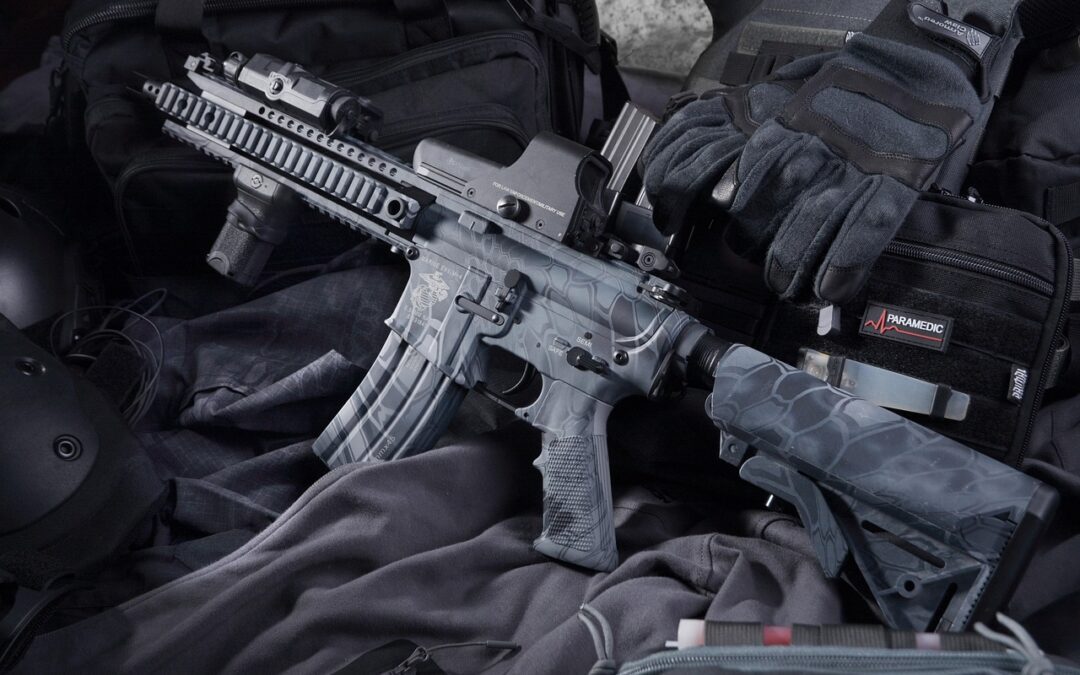
3D printing is also being used to produce certain functional airsoft gun components. Items such as triggers, stocks, scopes, and external housings can be manufactured using durable materials when printed correctly.
This approach is especially valuable when players need upgrades or replacements fast. Waiting weeks for a shipped part can pause gameplay entirely, while 3D printing allows players to test and refine parts in a much shorter time frame. Industrial processes like MJF provide tight tolerances and balanced strength, making these parts more reliable than typical hobby-printed alternatives.
Custom Decals and Cosmetic Enhancements
Customization is a major driver behind 3D printing in airsoft. Instead of relying on stickers or decals, players can integrate team logos, symbols, or patterns directly into printed parts. This creates a cleaner look and a more durable finish that does not peel or fade over time.
Post-processing expands these options even further. After printing, parts can be:
-
Sanded and polished for a smooth finish
-
Painted or dyed to match a specific color scheme
These techniques allow players to create builds that stand out while still maintaining a professional appearance.
Fast Replacement Parts and Repairs
Breakdowns are a common frustration in airsoft, especially when a small component fails and stops an entire build from functioning. Many players search for ways to get replacement airsoft parts quickly, and 3D printing has become one of the best solutions.
While a 3D model is required, the large 3D printing community has made this easier than ever. Online libraries such as Thingiverse and 3DWorld host thousands of free files for airsoft accessories, replacement parts, and cosmetic upgrades. This allows players to restore functionality without designing parts from scratch or waiting for shipping.
What Airsoft Parts Should NOT Be 3D Printed
Despite its versatility, 3D printing is not suitable for every airsoft component. Certain parts experience high stress, pressure, or safety risks and should be manufactured using traditional methods or metal materials.
Parts that generally should not be 3D printed include:
-
High-pressure or gas-containing components
-
Structural parts critical to player safety
-
Components that experience repeated impact or extreme wear
Understanding these limitations helps ensure safe and reliable gameplay.
Rule Compliance
Most airsoft events and fields inspect equipment to ensure it meets safety and performance standards. Even if a part is well-designed, it may not be allowed in organized play.
Players should always:
-
Check field and event rules before using custom parts
-
Confirm that printed components meet size and safety requirements
-
Avoid modifications that could give an unfair advantage
3D printing offers flexibility, but compliance with rules is essential for participation.
Why Industrial 3D Printing Is Better Than Hobby Printing
While hobby-level printers are accessible, industrial 3D printing offers significant advantages for airsoft applications. Industrial processes provide stronger materials, more consistent results, and tighter tolerances.
Key benefits include:
-
Better surface finish with minimal post-processing
-
Improved durability and repeatability
-
Balanced mechanical strength across all directions
-
Higher accuracy for parts with tight clearances
These factors make industrial 3D printing a better option for players who want long-lasting, high-quality components.
Conclusion
3D printing has transformed how airsoft players approach upgrades, repairs, and customization. From grips and magazines to accessories and replacement parts, additive manufacturing allows for faster production, greater personalization, and improved availability. When used responsibly and in compliance with field rules, 3D printing offers a powerful way to enhance both performance and creativity within the airsoft community.