
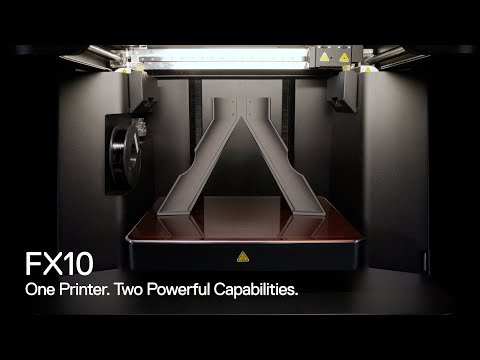
One Machine for Metal and Composite Parts
Industrial 3D printing company Markforged recently announced the FX10 Metal Kit. This upgrade transforms their composite printer into a dual-capability system. Engineers can now produce both metal and continuous fiber parts on a single machine.
The FX10 Metal Kit addresses a common manufacturing challenge. Teams often need both high-strength composite parts and metal components. Previously, this required separate equipment or multiple vendors.
What the FX10 Metal Kit Offers
The FX10 platform combines two distinct printing technologies. Composite printing uses continuous fiber reinforcement for lightweight strength. Metal printing uses bound metal deposition for functional metal parts.
Key capabilities include:
- Continuous carbon fiber, fiberglass, and Kevlar reinforcement
- 17-4 PH stainless steel metal printing
- Single machine footprint for both processes
- Industrial-grade precision and repeatability
This combination matters for production environments with limited floor space. One machine serving two functions reduces equipment costs and training requirements.
Practical Applications for Manufacturing Teams
The dual-capability approach opens several use cases. Engineering teams can prototype in composite, then switch to metal for final validation. This accelerates the design iteration cycle significantly.
Tooling and Fixtures
Manufacturing fixtures often require both material types. Composite jigs offer lightweight handling advantages. Metal fixtures provide durability for high-wear applications.
Production teams can now address both needs in-house. This reduces lead times compared to outsourcing metal parts separately.
End-Use Part Production
Some assemblies require mixed materials. A single platform simplifies production planning. Teams maintain consistent quality control across both part types.
Considerations for Procurement Teams
Before investing in dual-capability equipment, evaluate your actual needs. Consider these factors:
- Current volume of metal versus composite parts
- Lead time requirements for each material type
- Post-processing capabilities for metal parts
- Total cost of ownership versus outsourcing
Bound metal deposition requires sintering after printing. This means additional equipment or furnace access. Factor this into your capital planning.
How This Compares to Other Industrial Options
Different applications call for different solutions. Metal 3D printing processes vary widely in capability and cost. Bound metal deposition suits small to medium parts with moderate complexity.
For high-volume polymer production, processes like Multi Jet Fusion or Selective Laser Sintering may prove more cost-effective. These technologies excel at batch production without tooling.
When to Consider Outsourcing
Not every facility needs in-house metal printing. Lower volumes or occasional metal parts often make outsourcing more economical. Industrial service providers like JawsTec offer multiple processes without capital investment.
Evaluate your annual part volume realistically. Equipment utilization below 60% typically favors outsourcing. Request a quote to compare in-house versus service bureau costs.
The Broader Trend in Industrial AM
The FX10 Metal Kit reflects a larger industry movement. Manufacturers want flexibility without complexity. Multi-material and multi-process machines address this demand.
However, specialized equipment often outperforms hybrid solutions in specific applications. The best approach depends on your production mix and strategic priorities.
Engineering teams should test parts from multiple processes before committing. This ensures the chosen technology meets your actual performance requirements.
Sources
Source: FX10: One Printer. Two Powerful Capabilities. FX10 Metal Kit Now Shipping. by Markforged (YouTube) — https://www.youtube.com/watch?v=_lQjlBVkTAo