
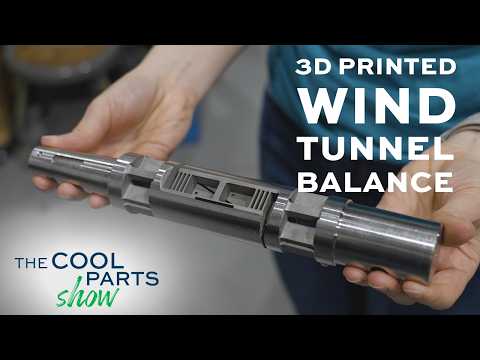
NASA’s New Approach to Aerospace Testing
NASA engineers face constant pressure to test designs faster. Traditional wind tunnel tools took months to manufacture. Now, 3D printed wind tunnel tools are cutting that timeline dramatically.
The Cool Parts Show by AM Media recently featured NASA’s innovative approach. They’re using metal additive manufacturing for critical testing equipment. The results show what’s possible when aerospace meets advanced manufacturing.
What Are Wind Tunnel Balances?
Wind tunnel balances are precision instruments. They support aeronautical models during testing. They also house sensors that measure forces and moments.
These tools must be incredibly accurate. Any flex or distortion skews test data. Traditional machining required extensive lead times and multiple setups.
Why Traditional Manufacturing Falls Short
Conventional balance production involves complex multi-axis machining. Engineers often wait 3-6 months for a single tool. Design iterations multiply these delays significantly.
- Multiple machining operations required
- Long lead times for specialty materials
- Limited geometric complexity possible
- High costs for design changes
How Metal 3D Printing Changes the Game
NASA turned to metal 3D printing for faster results. They can now produce balance components in weeks. This acceleration transforms their testing workflow.
The additive approach enables complex internal geometries. Sensor channels and mounting features print as one piece. Post-processing remains necessary but overall time drops significantly.
Key Performance Improvements
NASA reports approximately 75% reduction in production time. This speed enables more design iterations. Engineers can test concepts that were previously impractical.
- Production time reduced from months to weeks
- Complex internal channels possible
- Consolidated part counts
- Faster design iteration cycles
Practical Takeaways for Your Operations
NASA’s success offers lessons for any manufacturer. Testing equipment and tooling are prime AM candidates. The ROI comes from speed, not just part cost.
Consider your current tooling bottlenecks. Where do long lead times delay your projects? These pain points often justify additive manufacturing investment.
When to Consider Metal AM for Tooling
Not every tool benefits from 3D printing. Focus on components with these characteristics:
- Complex internal features or channels
- Low volume production requirements
- Frequent design iterations needed
- Long traditional manufacturing lead times
Understanding print orientation helps optimize these parts for AM.
Material Considerations for Precision Tools
Wind tunnel balances demand specific material properties. Stiffness and dimensional stability are critical. Metal AM offers various alloys suited to these needs.
NASA’s application likely uses steel or nickel alloys. These materials provide the rigidity precision testing requires. Your material choice depends on your specific application demands.
Learn more about high-strength 3D printing materials for demanding applications.
Getting Started with Industrial AM
You don’t need NASA’s budget to benefit from additive manufacturing. Many manufacturers start with prototype tooling. Success in one application builds confidence for broader adoption.
JawsTec helps manufacturers identify high-value AM applications. Our team can evaluate your tooling needs. Request a quote to explore your options.
Start Small, Scale Smart
Begin with a single tooling project. Measure time and cost savings carefully. Use that data to justify expanded AM adoption.
NASA’s wind tunnel success demonstrates AM’s potential. Your operation can achieve similar improvements. The key is identifying the right applications first.
Sources
Source: How NASA Is 3D Printing Wind Tunnel Tools to Speed Up Space Testing | The Cool Parts Show by AM Media — The Cool Parts Show (YouTube) — https://www.youtube.com/watch?v=gPLM_C5dA88